Boosey & Co. Pratten's Perfected
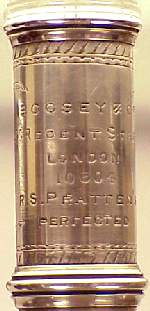
Barrel maker's marks
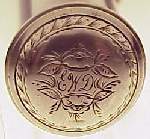
Crown monogram of original owner?

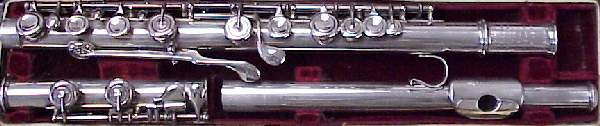
Boosey & Co. "Pratten's Perfected"
Serial # 10604; London; 1879(?); Silver body and mechanism, soldered tone holes; sl 585mm; 402g; .011"h .013"b


A "cutting edge reactionary," Robert Sydney Pratten (1824-1868) assumed the mantle from Charles Nicholson as Britain's favorite flutist and quickly extended his reputation throughout Europe as performer, composer and innovator.  While in his mid-20's he switched briefly from the standard 8-keyed flute to the new Siccama diatonic flute, but soon he was improving simple system flutes himself.  Recognizing the advantages of the Boehm cylinder flute but averse to learning the awkward new fingerings, Pratten decided to adapt Richard S. Rockstro's 1852 specifications for size and placement of tone holes while adapting the mechanism to allow continued use of "simple system" fingering.  In 1956 Pratten and a collaborator entered business with Thomas Boosey, Jr. to add a flute-making division to the young Boosey & Co. instrument manufacturing enterprise. Indeed, the "Pratten's Perfected" series of conical and cylindrical flutes continued to comprise the bulk of the Boosey & Co. flute output through the end of the century.
 

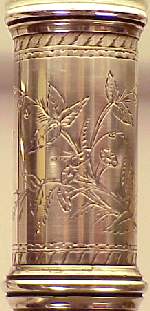
Decorative barrel engraving
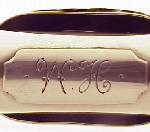
Monogram of later owner opposite embouchure?
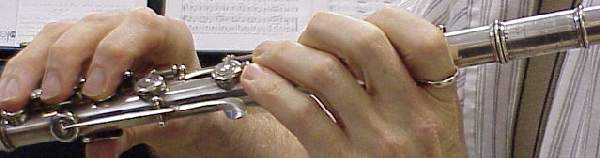
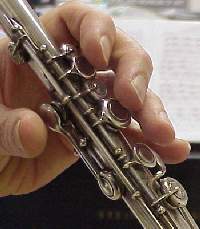
Index ring for left hand and saddle for right thumb
The saddle for the right thumb and ring support for the left index finger make the flute remarkably stable, even with all key touches up.  Since the left thumb key down opens its tone hole, this stabilizing device is a must.  Indeed, it is so comfortable that I'm rather surprised it has not been adapted as a standard option on modern flutes.

My best guess has this flute made around 1879, so it should have been about as perfected as it could get.  Solid silver and ornately engraved, the original owner thought highly enough of the instrument to have his initials "EWD" engraved on the crown and case, and a later owner added a plaque with the less ornately engraved "W.H." ... or maybe "H.M."?

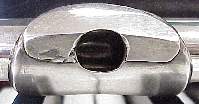
At some point the embouchure was further "perfected" to provide a more acute blowing edge (rather like the modern Julius Baker model Yamaha AC headjoint).  A rather ugly and kludged-together looking job, it actually plays rather well!

Index ring provides stability even with all fingers up
Modification to embouchure - ugly but successful
The flute was found by Steve Cole, who acquired it from an estate in New South Wales.  The possibilities for bringing it back into playing condition are still being evaluated at this time.

GoferJoe's Flutes
GoferJoe's Personal Page
GoferJoe's Arts Burrow

Images © J. W. Sallenger